Program Overview
The quality of hazardous area work in any organization depends on the quality of the people who train its technicians. An Ex instructor must hold deep technical command of explosion protection and be able to transfer it, correcting misconceptions before they become installation defects in a live plant.
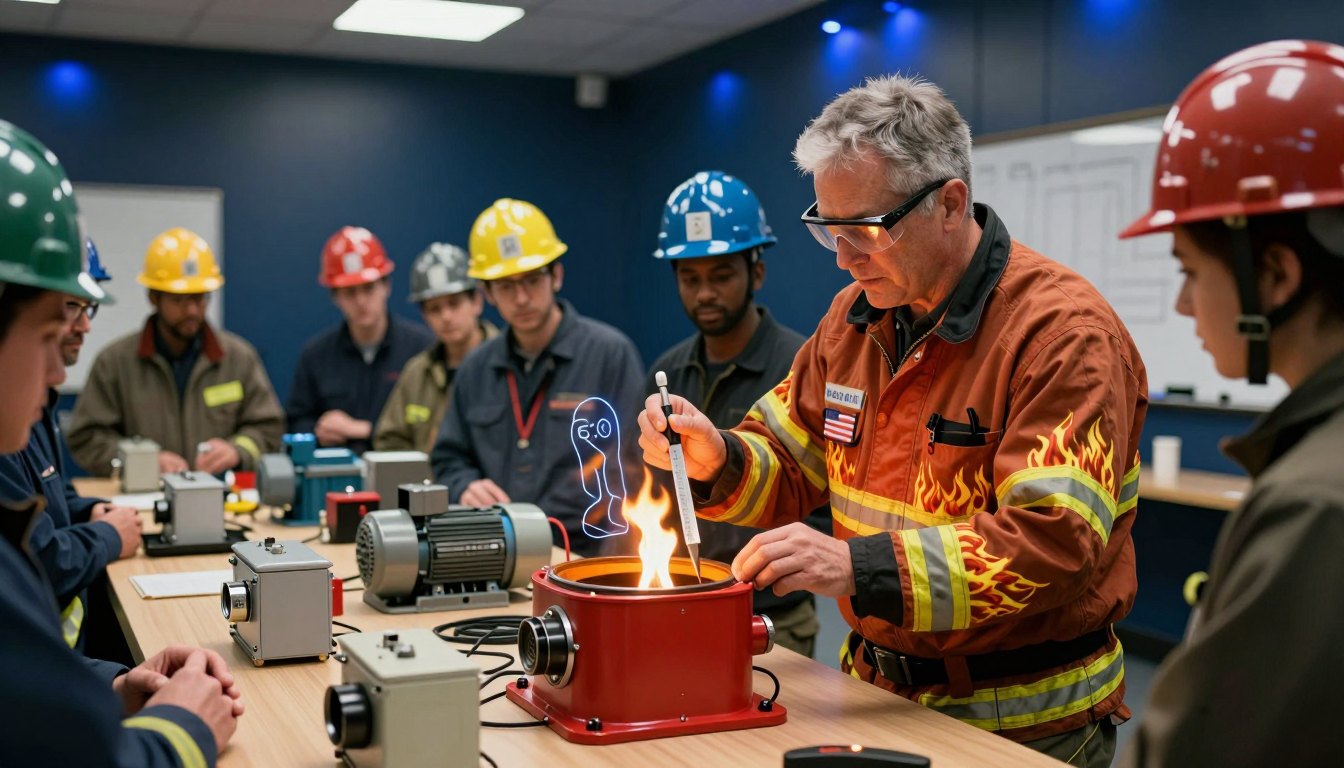
This ten-day program serves two purposes. First, it consolidates expert-level knowledge across the full Ex lifecycle: classification, protection concepts, certification and marking, installation to Ex 003, inspection to Ex 007, and supervision of repair and overhaul of Ex d, Ex e, Ex i and Ex p equipment. Second, it develops the instructional skills needed to deliver this content, including lesson planning, practical demonstration, competency assessment and feedback to learners.
Learning Outcomes
- Explain explosion theory, flammability parameters and area classification at a level suitable for teaching others
- Demonstrate the design principles and failure modes of each type of protection from Ex d to Ex s
- Verify Ex equipment certification, marking, intrinsically safe loop parameters, earthing and bonding
- Supervise installation, inspection and repair of explosion-protected equipment in line with IEC 60079-14, -17 and -19
- Plan and deliver Ex theory lessons and practical demonstrations to adult technical learners
- Assess candidate competence objectively using written tests, practical checklists and observation records
Program Modules
- Hazardous Zones and Principles of Protection — zone concepts, equipment protection levels and protection philosophy
- Explosion Theory and Properties of Materials — gases, liquids, solvents and combustible dusts
- Flammability Parameters — flash point, ignition temperature, LEL/UEL, density, gas groups and temperature classes
- Ignition Sources — electrical arcs, frictional sparks, hot surfaces and static electricity
- Methods of Protection in Depth — Ex d, Ex e, Ex p, Ex q, Ex o, Ex ia/ib/ic, Ex m, Ex n and Ex s design principles
- Certification, Marking and Ex Loop Verification — certificate review, IS entity parameters, earthing and bonding
- Ex Motors, Gas Detection and Permit to Work — protected motors and protection devices, gas detectors and PTW systems
- Installation of Explosion-Protected Equipment (Ex 003) — selection, erection and wiring system practice
- Visual and Close Inspection (Ex 007) — inspection grades, defect classification and reporting
- Supervising Repair and Overhaul — repair of Ex d, Ex e, Ex i and Ex p equipment to IEC 60079-19
- Instructional Techniques and Assessment — lesson design, practical demonstration, questioning and competency assessment
Who Should Attend
- Senior Ex technicians and engineers moving into training roles
- Training center instructors delivering hazardous area programs
- Corporate competency and training managers in oil, gas and chemical sectors
- Ex inspection leads who mentor field teams
Standards & Codes Referenced
- IEC 60079-0 (Explosive Atmospheres: General Requirements)
- IEC 60079-10-1 (Classification of Areas: Explosive Gas Atmospheres)
- IEC 60079-14 (Electrical Installations Design, Selection and Erection)
- IEC 60079-17 (Electrical Installations Inspection and Maintenance)
- ISO 16852:2016 (Flame Arresters)
- IEC 61241-0, -1, -4, -11, -18 (Equipment for Use with Combustible Dust)
- IEC 61779 (Flammable Gas Detection Apparatus)
- IEC 62013-1 and -2 (Caplights for Use in Mines Susceptible to Firedamp)
- IEC 60079-19 (Equipment Repair, Overhaul and Reclamation)
Assessment & Certification
Assessment has three parts: an advanced written examination on explosion protection, a practical assessment covering installation, inspection and repair supervision, and a teaching assessment in which each candidate delivers and assesses a micro-lesson under observation. Practical sessions take place at ASEEE-approved training centers.
Successful candidates are awarded the ASEEE competency certificate, issued with a unique certificate ID that employers and clients can verify online through Certificate Check. ASEEE recommends recertification every 3 years to keep competence aligned with current standards, equipment and site practice.