
Program Overview
Every measurement in a plant is only as good as the instrument behind it and the instrument that calibrated it. A calibration technician who understands reference standards, error, uncertainty and traceability protects product quality, process safety and regulatory compliance at the same time.
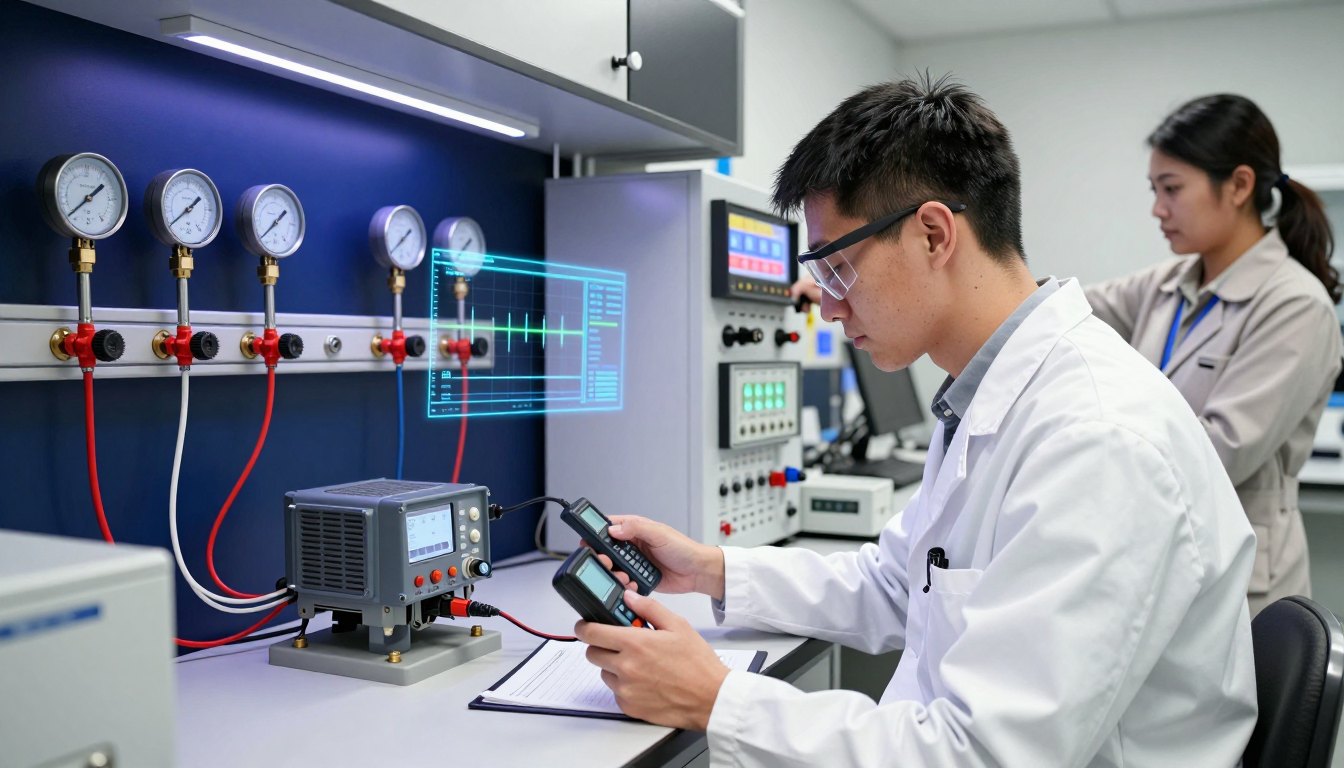
This five-day program builds the core skills of an instrumentation and electrical calibration technician. Participants calibrate digital multimeters, pressure gauges and calibrators, dry-block temperature calibrators with RTDs and thermocouples, 4-20 mA and HART loop calibrators and insulation resistance testers, then apply those references to pressure, temperature, level and flow transmitters. Throughout, the course applies ISO/IEC 17025 principles of traceability and uncertainty, IEC 61557 requirements for low-voltage test equipment, ISA-51.1 terminology and the IEC 60751 and IEC 60584 references for RTDs and thermocouples. Participants finish the week able to choose the right reference for a task, state the uncertainty of their result and defend a pass or fail decision.
Learning Outcomes
- Explain calibration concepts, including accuracy, error, hysteresis, uncertainty and traceability
- Calibrate and verify digital multimeters against a multifunction reference
- Calibrate pressure gauges and pressure calibrators using deadweight and electronic references
- Calibrate temperature instruments using dry-block calibrators, RTDs and thermocouples
- Use process calibrators for 4-20 mA and HART loop calibration
- Verify insulation resistance testers and other electrical test equipment
- Calibrate pressure, temperature, level and flow transmitters and record traceable results
Program Modules
- Calibration Fundamentals and Traceability — terminology, error calculation, test uncertainty ratio and ISO/IEC 17025 principles
- Digital Multimeter Calibration Systems — multifunction calibrators, test points and verification of DMM functions
- Pressure Calibrators and Pressure Gauges — deadweight testers, pressure modules and gauge calibration
- Temperature Calibrators — dry-block calibrators, RTD and thermocouple characteristics and comparison calibration
- Process Calibrators — 4-20 mA sourcing and measuring, HART loop calibration and loop checks
- Insulation Resistance Testers — verification of megohmmeters and IEC 61557 test equipment requirements
- Pressure, Temperature, Level and Flow Transmitters — as-found and as-left calibration, trims and documentation
Who Should Attend
- Calibration and metrology technicians
- Instrumentation technicians
- Electrical technicians responsible for test equipment
- Quality and laboratory staff
- Graduates and apprentices entering instrumentation
Standards & Codes Referenced
- ISO/IEC 17025
- IEC 61557
- ISA-51.1
- IEC 60751
- IEC 60584
Assessment & Certification
Assessment combines a written examination on calibration principles, traceability and instrument-specific procedures with a practical assessment in which each participant calibrates a multimeter, a pressure gauge, a temperature sensor and a transmitter and completes calibration certificates with error and pass/fail evaluation. Practical sessions take place at ASEEE-approved training centers, using calibrated equipment and realistic work scenarios under the supervision of a qualified assessor.
Participants who meet the competency criteria receive an ASEEE competency certificate carrying a unique certificate ID that employers and clients can verify online through Certificate Check. ASEEE recommends recertification every 3 years to keep skills aligned with current practice and revised standards.